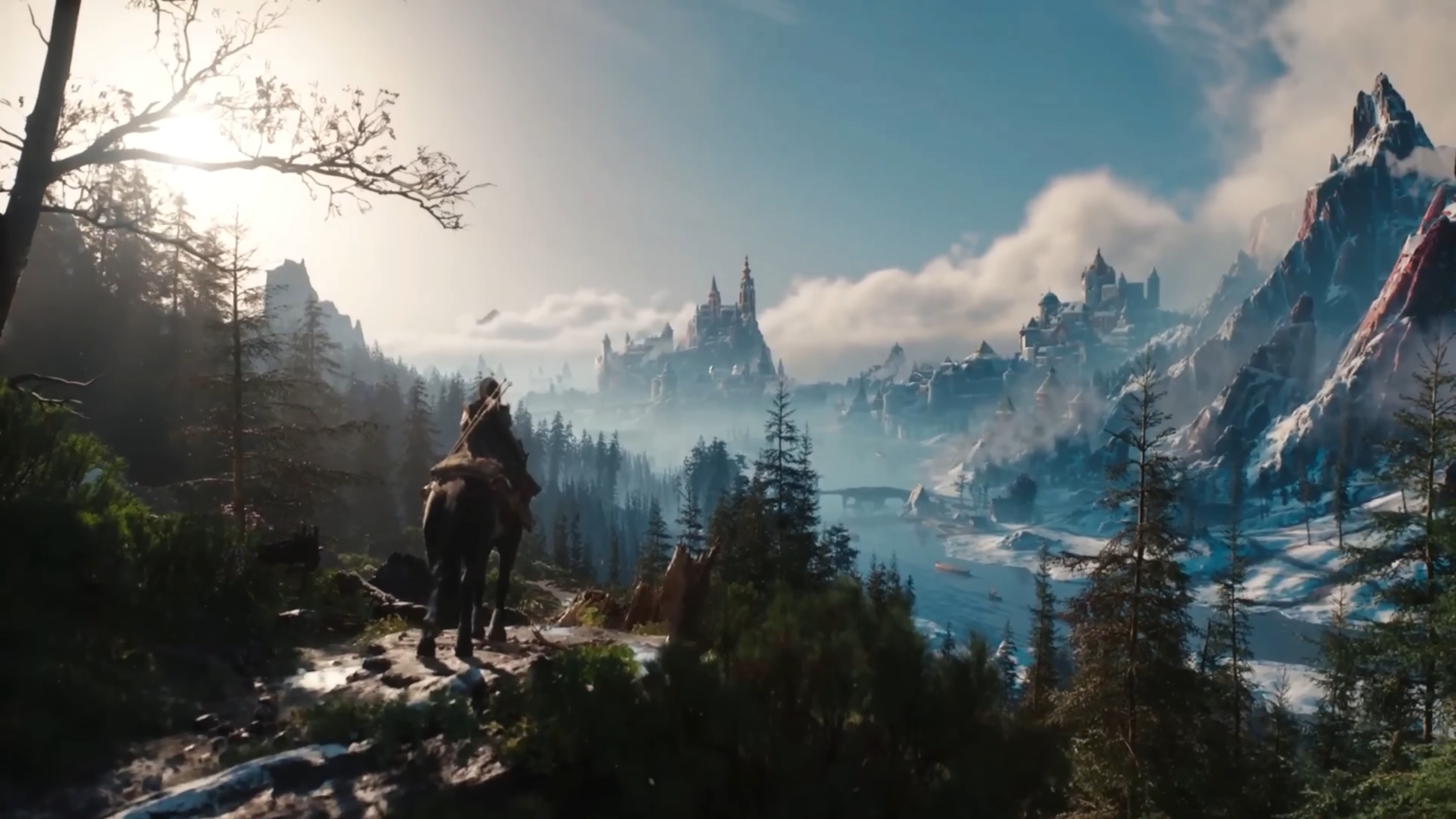
At this year's State of Unreal 2025 during Unreal Fest in Orlando, Epic Games and CD Projekt Red presented the first technology demo of The Witcher 4. The video, an approximately 9-minute engine demonstration, was released on YouTube on the official Unreal Engine channel and quickly attracted the attention of developers and series fans alike. The demo showed The Witcher 4 in motion for the first time, presenting gameplay running in real time. It is worth recalling that previously, at The Game Awards 2024, we had only received a cinematic trailer, discussed in our post The Witcher: the first trailer. That pre-rendered trailer, created in collaboration with Platige Image, revealed that Ciri would most likely be the protagonist of the new trilogy. Now, however, the technology demo lets us examine the actual capabilities of the game and Unreal Engine 5 under conditions resembling the intended gameplay.
The Witcher 4 technology demo: graphics, platform and reactions
The presentation began with a short cutscene showing Ciri escorting a prisoner by cart and being attacked by a monster, before moving smoothly into actual gameplay without a noticeable cut or loading screen. From the outset, it was confirmed that The Witcher 4 is being developed on Unreal Engine 5 through close collaboration between CDPR and Epic Games. Most impressive, however, was that this entire visually striking demonstration ran at 60 frames per second with ray tracing enabled on a standard PlayStation 5 console. As GamingBolt noted, “this is only a technology demo and does not necessarily represent the final product, but the fact that something so visually impressive runs on a base PS5 borders on madness”. PC Gamer also observed that “it ran on a standard PlayStation 5, not Pro, at a stable 60 fps with ray tracing enabled”, which is encouraging for the future PC version. In other words, next-generation visuals go hand in hand with strong performance, a pleasant surprise for audiences at such an early stage of development.
What technologies power this demonstration? The demo was intended to illustrate several Unreal Engine capabilities essential to next-generation open-world games. Primarily, it used Lumen global illumination to provide realistic reflections and lighting in real time, and Nanite technology , including the innovative Nanite Foliagesystem for displaying extremely dense vegetation. Instead of traditional two-dimensional cards or billboards and levels of detail (LOD), every blade of grass, leaf and tree needle is a full 3D model that adapts its detail using voxels as the camera moves away. As a result, the forest in The Witcher 4 looks natural and dense, and a camera flying through the undergrowth reveals neither object loading nor sudden detail transitions. Epic highlighted that Nanite Foliage remains fully integrated with Lumen: every vegetation voxel is correctly lit and casts a dynamic shadow. Moreover, the entire scene, including terrain, rocks, trees and water, is rendered through Nanite while maintaining smooth performance. Occasional shadow artefacts were noted, with tree shadows appearing suddenly during very fast camera movement, but these may result from the standard PS5's limitations or an early software version.
Physics and animation are equally important pillars of the demo. Unreal Engine 5 introduced improvements to Chaos Physics , demonstrated through Ciri's horse, named Kelpie. The demo used Chaos Flesh Solver and Machine Learning Deformation, allowing the horse's muscles to move and deform realistically as it gallops. The muscles work beneath the skin almost as in reality, without a noticeable performance impact. The demo also used Root Motion for Kelpie's animation, anchoring the horse's movements in the game world and making them appear more natural. Combined with Multi-Character Motion Matching , which synchronises rider and mount animations, this produced “the next generation of horse riding”, as the developers describe it. Ciri can smoothly mount from either side at any speed while the animation remains consistent and realistic. The presentation also featured Chaos Cloth, advanced cloth simulation that makes the protagonist's cape and clothing respond credibly to movement, adding realism to every scene.
One of the demo's most impressive elements was the behaviour of non-player characters (NPCs) and crowds. In a scene set in the port town of Valdrest, we saw hundreds of surprisingly detailed characters engaged in their own activities, from watching a trained bear perform to reacting to Ciri passing by. Using UE5 tools including MetaHuman, Smart Objects and MASS, CD Projekt Red showed that NPCs react dynamically to the player's actions, triggering chain reactions in their surroundings. For example, bumping into a market trader causes a crate of apples to fall, fruit to scatter across the cobbles and a brief exchange with the irritated merchant. Such interactive events, and even the ability to toss coins to a beggar, create the impression of a living world. The new animation framework in Unreal Engine allows the screen to show over 300 skeletal NPCs simultaneously at 60 FPS, promising towns and settlements more alive than ever. The developers aim to minimise the gap in quality and behaviour between the protagonist and background characters. MetaHuman technology, smart objects that NPCs can interact with contextually, and clothing simulation through Chaos Cloth make characters look more natural and credible in their reactions.
How did the media and players respond? The overall reception was enthusiastic, particularly within communities focused on graphics and technology. Many journalists admitted that no major sandbox had excited them so much in a long time. As a PC Gamer editor put it: “setting professional distance aside for a moment, I have to admit this demo won me over… against my better judgement, I felt the hype”. Particular attention was paid to Ciri. After years of becoming accustomed to Geralt as protagonist, changing the main character initially caused some concern. However, the technology demo largely dispelled those doubts : Ciri looked excellent in both design and animation. CD Projekt Red retained her classic appearance from The Witcher 3, as officially confirmed: “Ciri's face is a direct copy of the model from The Witcher 3, adapted to the latest MetaHuman technology”. Changes were limited to minor facial adjustments, such as slightly raised eyebrows and a more relaxed eye area; one was subsequently reversed following fan reactions. This attention to the original details was received very positively. Players appreciated CDPR listening to community feedback and preserving continuity in the character's appearance. As a result, controversy over choosing Ciri as the protagonist largely faded, giving way to excitement about how well she fits her new role as a witcher.
Interestingly, the demo's positive reception also had a business impact. CD Projekt shares soared by approximately 5–6% immediately after the presentation, gaining almost 13% in total over two days. Investors clearly responded to the enthusiastic reception of the technology showcase, with the share price reaching its highest levels since early 2021. This sharp rise reflects confidence that The Witcher 4 can repeat the success of The Witcher 3and that collaboration with Epic Games will provide solid technological foundations, avoiding the problems that affected Cyberpunk 2077 at launch. In a press release, Michał Nowakowski, Joint CEO of CDPR, called the presentation “a significant milestone” in the Epic partnership, while narrative director Philipp Weber emphasised that making Ciri the protagonist was a bold but appropriate decision to refresh the series. The final game is still a long way off, with release not expected before 2026–2027 , but it is already clear that CDPR is pursuing the most ambitious and immersive open world in RPG history.
What PC would match the PS5's capabilities?
Finally, it is worth discussing hardware requirements. The demo ran on a PS5, roughly equivalent to a mid-range PC from 2020 (8-core Zen2 CPU at approximately 3.5 GHz, approximately 10.3 TFLOPS RDNA2 GPU, 16 GB RAM). Maintaining 60 FPS with Lumen and ray tracing enabled suggests that a PC with similar specifications should handle these graphics. An estimated equivalent would be a powerful graphics card such as a GeForce RTX 3070 or Radeon RX 6800 with approximately 10–13 TFLOPS of computing power, supported by a modern 8-core processor such as an Intel Core i7-12700 or AMD Ryzen 7 5800X and 16 GB of RAM. Much will, of course, depend on the final game's optimisation and the techniques used; the resolution was probably upscaled using UE 5 Temporal Super Resolutionto reduce GPU load. Nevertheless, Unreal Engine is now emphasising performance, as Epic representatives confirm: the main goal of version 5.6 is further performance improvement rather than graphical showpieces alone. This is good news for PC players, suggesting that extremely expensive hardware will not be needed for smooth gameplay at the demo's quality.
Unreal Engine 5 developments: from GDC 2025 to future versions
The Witcher 4 technology demo was intended not only to excite fans, but also to highlight new Unreal Engine featuresthat AAA developers will use in the coming years. State of Unreal 2025 officially introduced Unreal Engine 5.6, and Epic Games discussed improvements in graphics, lighting, animation, AI and world streaming. Importantly, all the technologies presented were made available to developers “starting with today's release of Unreal Engine 5.6” through updates published progressively. As noted, this means other studios will also be able to create credible, compelling open worlds at 60 FPS without compromising quality, regardless of project scale. Below, we examine the key UE5 developments demonstrated in The Witcher 4.
Graphics and lighting
The greatest emphasis was placed on rendering techniques that enable next-generation quality in large worlds while maintaining performance. The previously mentioned Nanite Foliage is the flagship innovation, first seen in The Witcher 4 demo. Nanite vegetation can fill forests and fields with dense, detailed flora without reducing frame rates. Every leaf and twig is a Nanite object whose voxel detail changes continuously, so a distant tree is represented as a point cloud or voxel cloud, without the player noticing. Problems involving trees animated by wind and their interaction with Lumen have also been addressed. Nanite Foliage in UE5.6 handles moving objects and translucent materials such as leaves and grass better alongside global illumination. Meanwhile, Lumen, responsible for ray tracing and GI, has gained a 120 Hz mode for future, more powerful consoles and optimisations for weaker hardware. Epic is also working on “MegaLights” , described as “Nanite for lights” and announced in UE 5.5, suggesting that light sources will soon become more numerous and less computationally expensive. Also on the horizon is a new terrain system: current heightfield landscapes are to be replaced by a fully 3D solution offering “Nanite-level” detail even for mountains and hills. This matters for games like The Witcher, where extensive terrain with many elevation levels is challenging. Epic acknowledges that UE's existing terrain system lagged behind Nanite objects in detail, something intended to change in upcoming engine versions.
Character animation and simulation
The second pillar of improvements is character animation and related physical simulations. Unreal Engine 5.6 introduces Unreal Animation Framework , a unified animation pipeline known internally as Anim Next. Its capabilities were visible in the demo, where Ciri moved freely through crowds and Kelpie responded to the rider's every movement. The key technique is motion matching for multiple characters simultaneously. NPC animations can be selected dynamically from a large database to match the situation, such as smoothly avoiding collisions with the player or reacting to stimuli. For the protagonist and horse, the demo used multi-character motion matching, enabling precisely synchronised movements, including mounting while running, jumping and turning. UE5 also offers an improved Control Rig and so-called Physics Rigs , physical rigs allowing body elements to be simulated in the engine, such as body balance, hair physics or clothing parts. We saw this in practice in the demo: Chaos Cloth was responsible for the credible behaviour of Ciri's clothing, and Chaos Flesh/Physics Rigs for Kelpie's muscle animation. Another new feature is the previously mentioned ML Deformer or Machine Learning Deformation, which uses machine learning to add subtle deformation details to an animated model. For example, a character's or animal's muscles can flex and tremble naturally without manually creating complex blend shapes. A neural network suggests the deformation shape based on prior training. This gives animations realism without burdening the CPU/GPU with excessive calculations. As international media vividly described it, CDPR targeted horse animation details like those in Red Dead Redemption 2, implementing “realistically moving and tensing muscles” beneath Kelpie's skin. Finally, improvements were also made to Twist Correctives and Motion Trails in the animation editor, alongside an announced full system of branching dialogues : animated, branching dialogue with control over cinematic sequences, which will certainly be useful in complex, nonlinear RPGs such as The Witcher 4.
Artificial intelligence, crowds and the open world
To make the open world feel truly alive, Unreal Engine 5 also received improvements in crowd AI and world streaming. One of the tools presented is MASS , the Massive AI System integrated with MetaHuman, designed to handle large, dynamic NPC crowds. MASS simulates the behaviour of hundreds of characters simultaneously with little performance overhead, distributing calculations across threads and using Level of Detail in AI logic. In practice, this produces scenes such as the Valdrest market, with over 300 characters moving smoothly and reacting to events. There is also the Smart Objectssystem of intelligent environmental objects: developers can mark a bench, stall or campfire as a smart object with assigned actions such as sitting, buying, selling or warming up. AI-controlled NPCs use these actions automatically, bringing the surroundings to life. We saw the results in The Witcher 4: people shelter from rain, street performers attract small crowds and guards patrol the walls, all emerging without centrally scripted paths. Artificial intelligence in UE5 also uses an improved perception system, helping NPCs see and hear events better, and Behavior Tree tools enhanced with Mass Signals , a mechanism for notifying multiple AIs of an event, such as a town alarm. This allows group reactions to cascade and spread more naturally.
The final piece of the puzzle is open-world infrastructure, meaning the streaming of enormous amounts of data. Unreal 5 had already introduced World Partition , a system dividing maps into sectors loaded on the fly. It has now received further improvements: World Partition Bookmarks help developers navigate huge maps more easily during their work, while data streaming itself has become more efficient, particularly in environments containing tens of thousands of objects. CD Projekt Red and Epic developed a module provisionally named FastGeo Streaming, demonstrated in The Witcher 4, intended to enable faster loading of surroundings and textures so that players do not experience loading even when travelling very quickly through the world. In the demo, the camera moved rapidly from forest to town and back without object pop-in or delayed texture loading, a problem in The Witcher 3, where NPCs or objects famously appeared just in front of the player. These improvements suggest that The Witcher 4 aims to eliminate loading screens entirely , creating a unified, seamlessly streamed sandbox world. It is also worth mentioning Procedural Content Generation (PCG) : UE5.2 introduced procedural generation, used in Fortnite among other games, while the roadmap includes so-called Megaworlds Biomes. These are ready-made biomes with defined procedural rules that can be published on the Fab marketplace and used to create enormous worlds more quickly. For games like The Witcher, this could make it easier to generate vast forests, villages or mountain ranges as a starting point, which artists can then enrich with unique details.
To be continued
The Witcher 4 technology demo demonstrated that CD Projekt Red takes the next generation seriously in both visual quality and stable performance. Moving to Unreal Engine 5 seems strategic: rather than building its own engine from scratch, the studio can focus on content and mechanics using a powerful, continually developed tool. Epic Games also benefits from the collaboration. As Tim Sweeney stated, “CD PROJEKT RED is one of the best open-world game studios, an ideal partner to help us develop new world-building features that we will make available to all Unreal Engine creators”. The results of this cooperation are already impressive: the demo was visually stunning with dense Nanite forests, realistic Lumen lighting and smooth animations, and technically impressive with 60 FPS on a console, no loading screens and NPC crowds. Of course, how much will appear in the final game remains an open question: the demo is illustrative. Nevertheless, as the developers themselves acknowledge, it is an important milestone and a promise of new quality in RPGs. If further progress follows over the coming months and these technologies reach The Witcher 4, we may expect a breakthrough production for the current hardware generation. We must remain patient until 2026+ and hope that the promises illustrated by the demo reach the final product. All signs suggest we are witnessing the birth of the most ambitious Witcher game in history.
Sources:
CD Projekt Red / Epic Games: The Witcher 4 UE5 Tech Demo (State of Unreal 2025)
PC Gamer: Witcher 4’s Nanite Foliage at 60 fps on PS5 (Nick Evanson)
TweakTown: Witcher 4 tech demo full breakdown (Jak Connor)