The 5000 series launch
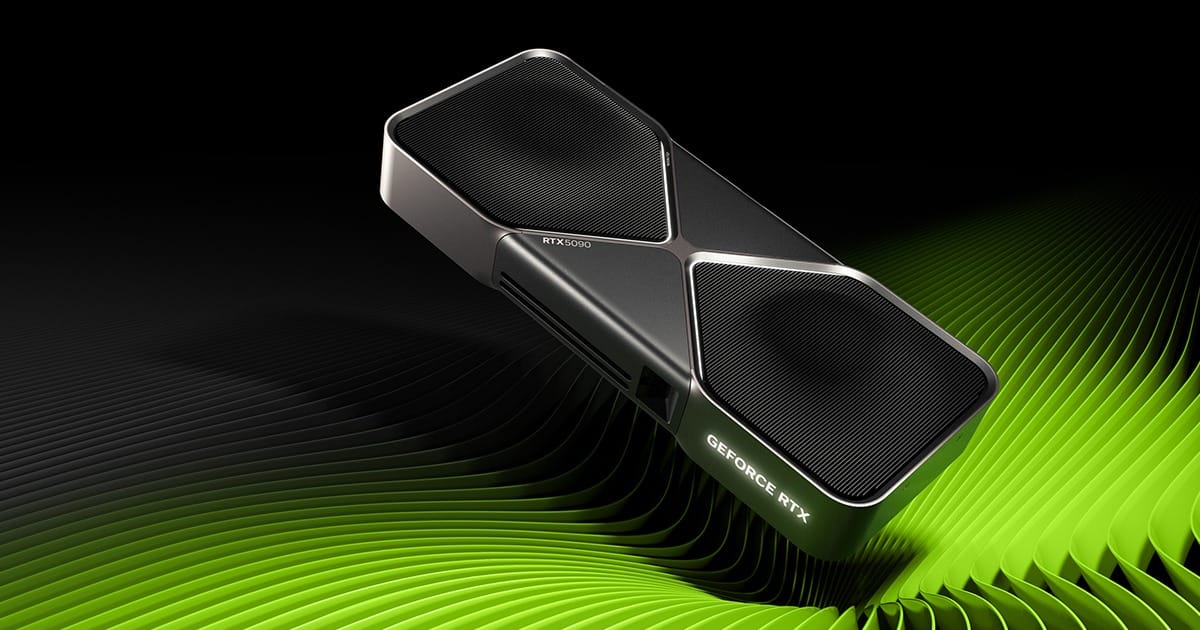
At CES 2025, Nvidia announced a new generation of graphics cards based on the NVIDIA Blackwell architecture. How will the new flagship RT5090 perform in 3D graphics? We will focus on its potential for photorealistic pre-rendered 3D graphics, leaving computer games somewhat to one side 🙂
New versus old
The first thing that stands out is the significantly greater gap between the specifications of the RTX5090 and RTX5080, larger than between the previous RTX4080 and RTX4090 generation. In our experience, the RTX4090 was 10-20% faster than the RTX4080 in most cases. Its main advantage was the much larger GDDR memory capacity: 24Gb compared with 16Gb in the RTX4080. Nevertheless, the RTX4080 performs very well in less demanding scenes.
GDDR memory
The RTX5090 will have 32Gb of GDDR7 memory, while the RTX5080 will retain 16Gb, like its predecessor. In both cases, memory bandwidth is expected to be much higher. The RTX5090 is expected to reach 1792 Gb/s compared with its predecessor's 1008 Gb/s. This is a large increase, but since the 1000 series, Nvidia has accustomed us to doubling flagship performance between generations.
RTX5070 = RTX4090 ?
The RTX5070 is now expected to deliver RTX4090 performance. If confirmed, that would be a good result because the RTX5070 will use much less electricity. In our opinion, this comparison may prove accurate in games. For professional applications, we need to wait and test. We suspect the RTX4090 may still have an advantage over the RTX5070. How extensively 3D software uses the new generation's functions will strongly affect its effectiveness. We will therefore discover its full potential only over time.
RTX5090 in AI
We recently published our advice about a computer for a 3D artist and mentioned the direction of PC development, particularly AI calculations. The new NVIDIA generation's specifications clearly confirm this direction. The RTX5090 is expected to perform 3352 quadrillion AI operations per second. The RTX4090 performed 'only' 1321 quadrillion operations per second. It is currently difficult to determine the effect on popular renderers such as V-Ray or Corona, whose AI core use is limited. However, they may be useful for interactive visualizations using Unreal or other tools, such as those from Chaos Group. AI computing cores are also being used increasingly well by simulation software, for example for particles.
DLSS4 is one of the most heavily advertised features, intended to generate 3 additional frames from one, greatly increasing frames per second in computer games.
Autodesk Arnold and V-Ray currently use ray-tracing and denoising hardware, so these will be the first places to experience the new chips' power. Adobe software will support AI hardware for selected functions. We can expect much faster video rendering, for example in Adobe Premiere Pro, through the sixth-generation NVENC encoder. In the RTX4090, NVENC is expected to be tripled.
Power consumption
In professional applications, performance relative to running costs is very important. These cards often operate 24/7 and consume kW of electricity. For the RTX5090, predictions of consumption close to 600W are proving accurate. Officially, the card should consume 575W at peak load. Despite officially high consumption, the 4000 generation allowed effective power limiting without performance loss. We have 4090 units whose average consumption falls well below 300W. This does not mean a weaker power supply can be used: we are discussing an average. How will the 5090 behave? We will see 🙂 We hope similarly 🙂
Competition
Everything suggests that Nvidia will remain in a class of its own in the top segment for the foreseeable future. ATI has already announced a focus on the mid-range, where it performs very well and its cards offer excellent value. Intel has not had a top-segment card so far and also struggles in the mid-range. This brings us to the final point…
Price
Without competition, the manufacturer sets the price. It will be expensive, but not more expensive than before, and not for every card.
Demand for cryptocurrency mining cards, supply disruption during Covid and production and stability problems with the 3000 generation have accustomed us to top-segment cards costing over 10 thousand PLN. The most powerful RTX5090 is expected to cost PLN 10299.
The RTX5080 looks much better on price, costing half as much. It may be an excellent choice for less demanding 3D enthusiasts and less complex scenes. We will see how availability develops. The 4000 series faced major shortages, and RTX4090 prices rose above 15 thousand PLN for a long time.
Interested readers can visit the official Nvidia page devoted to the new generation.