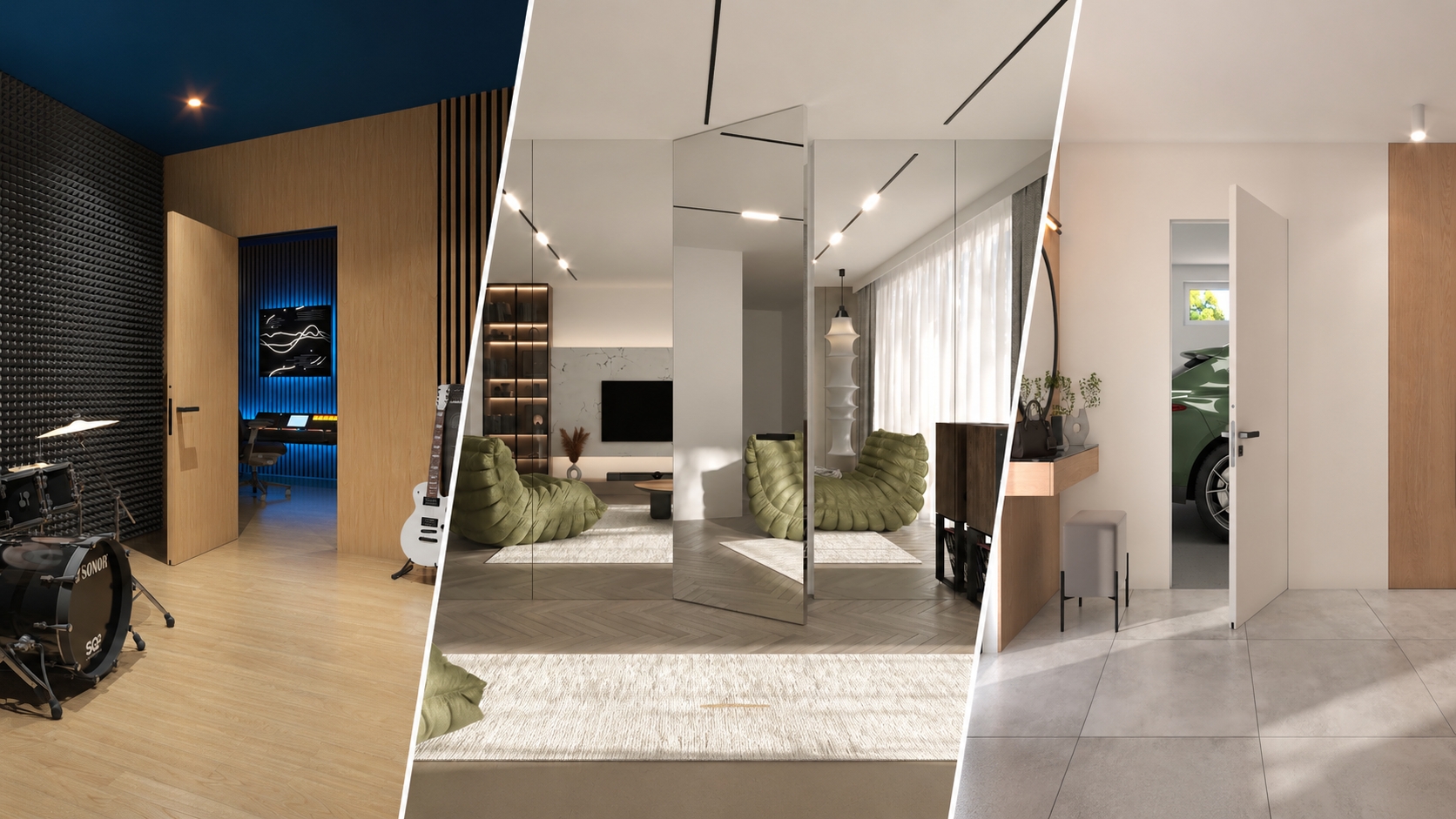
We created a series of photorealistic visualizations presenting concealed-frame doors in three completely different settings. Each scene was intended to show a different use of the product while maintaining a consistent, modern and timeless character.
The main advantage of concealed-frame doors is that they can blend almost completely into the wall surface. This is precisely why presenting them requires more than an attractive interior visualization.
The client's involvement was very important here. We received carefully prepared guidelines on the desired style, the character of the interiors, how the doors should be presented and which elements should appear in each setting. The client spent considerable time gathering information and clarifying their needs, allowing us to design scenes that matched the actual purpose of the visualizations from the outset.
This is an important part of the entire process. Even the best technical capabilities cannot replace good communication and a clearly defined goal. In this case, detailed materials and specific client expectations allowed us to focus on refining the scenes and showing the product in the most attractive yet credible way possible.
The project is an example of our 3D product visualizations for manufacturers.
Acoustic doors in a professional recording studio
The first visualization showed the doors in a professional recording studio. This was not a typical residential, office or commercial interior, so the scene required the creation of many unusual elements.
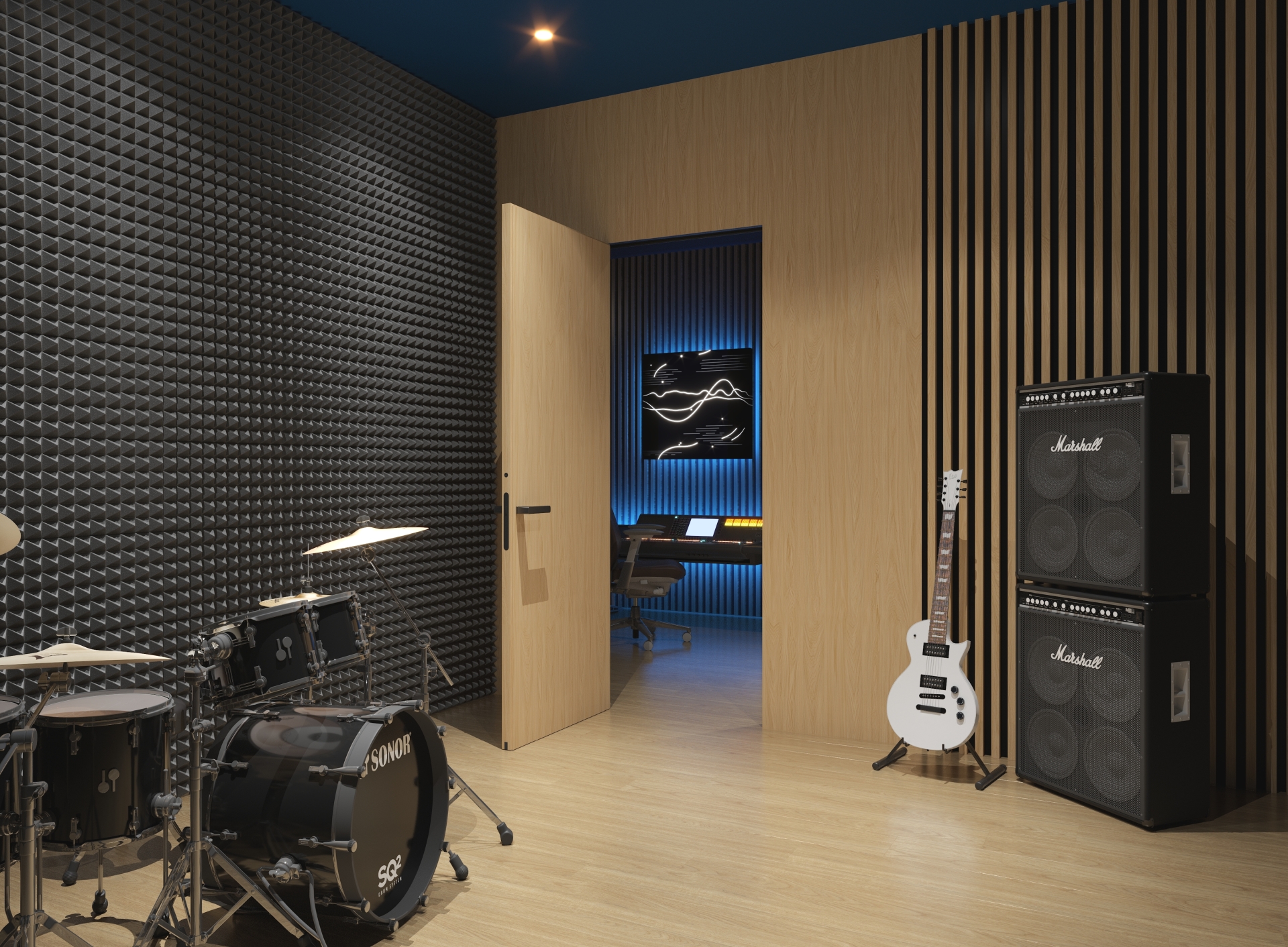
The room was furnished with sculptural acoustic panels, musical instruments, a drum kit, a guitar, amplifiers and equipment for recording and audio production. Each object had to suit the scale of the room and create a credible professional studio environment.
Designing the acoustic panels appropriately was particularly important. Their regular geometric structure covers a large part of the wall and is one of the setting's most distinctive features. At the same time, it could not dominate the product being presented.
The doors were integrated into a wooden surface, making their concealed construction apparent without disrupting the interior's minimalist character. The open door leaf reveals the passage into another studio room and helps explain how the product is actually used.
Doors concealed in a mirrored wall
The second scene was much more demanding in terms of composition. Its main feature was a mirror-covered door integrated into a wall whose remaining surface also consisted of large mirror panels.
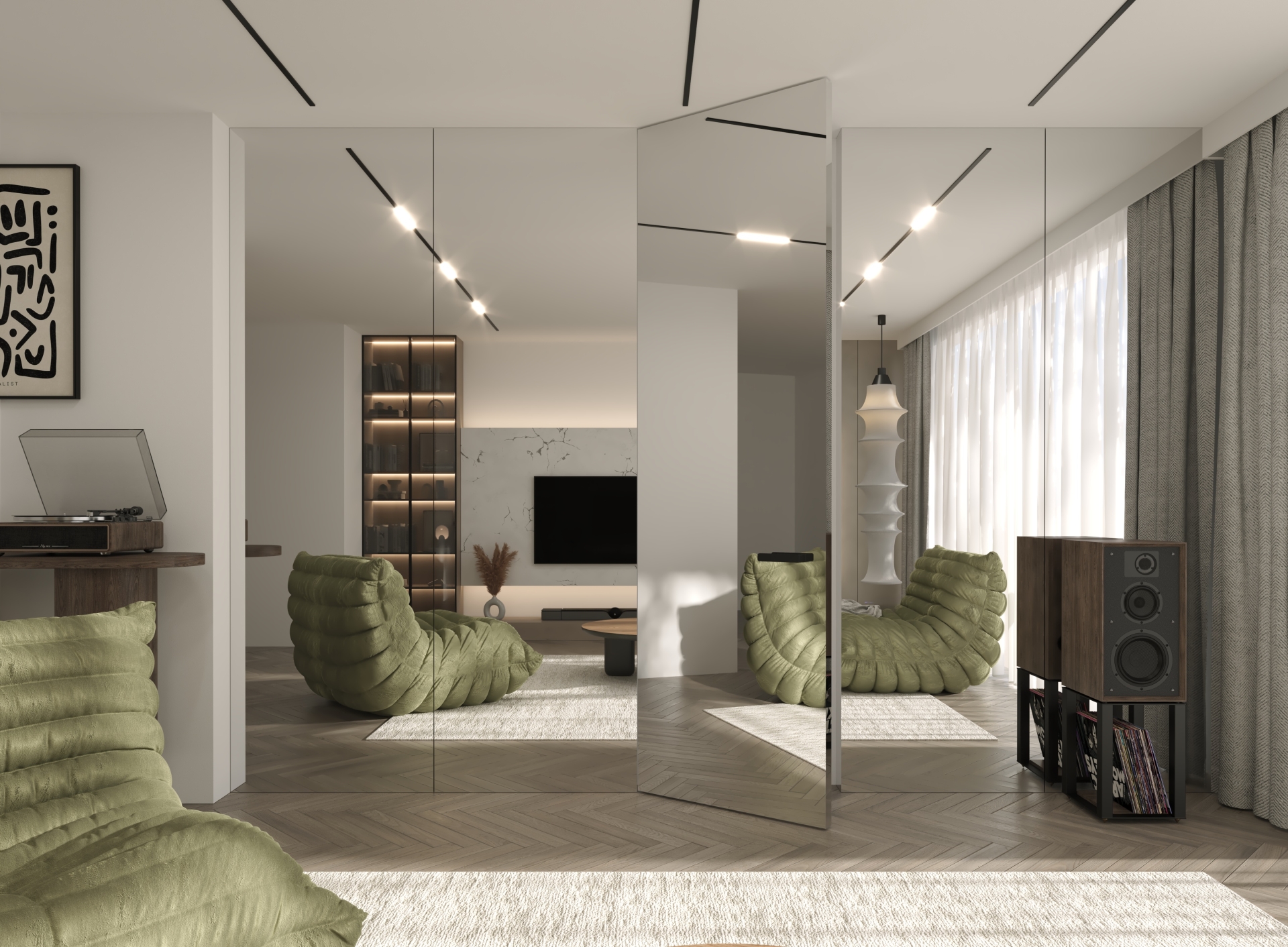
Interior visualizations featuring many mirrors are particularly challenging. Reflections can create confusion and make the space difficult to understand. It is not always immediately clear which objects are directly in front of the camera and which are merely reflections. A poorly designed composition could therefore cause viewers to miss the door or fail to understand how it works.
Our task was to present the entire concept in a visually expressive, attractive and immediately understandable way. At first glance, the viewer should recognise a mirror-finished wall incorporating a door leaf with a concealed frame.
Controlling all reflections was very important in this scene. Every visible part of the armchair, floor, lighting or fitted furniture had to correspond to the spatial layout.
The passage from the house to the garage
The third visualization showed a concealed-frame door as a passage from the living area to the garage.
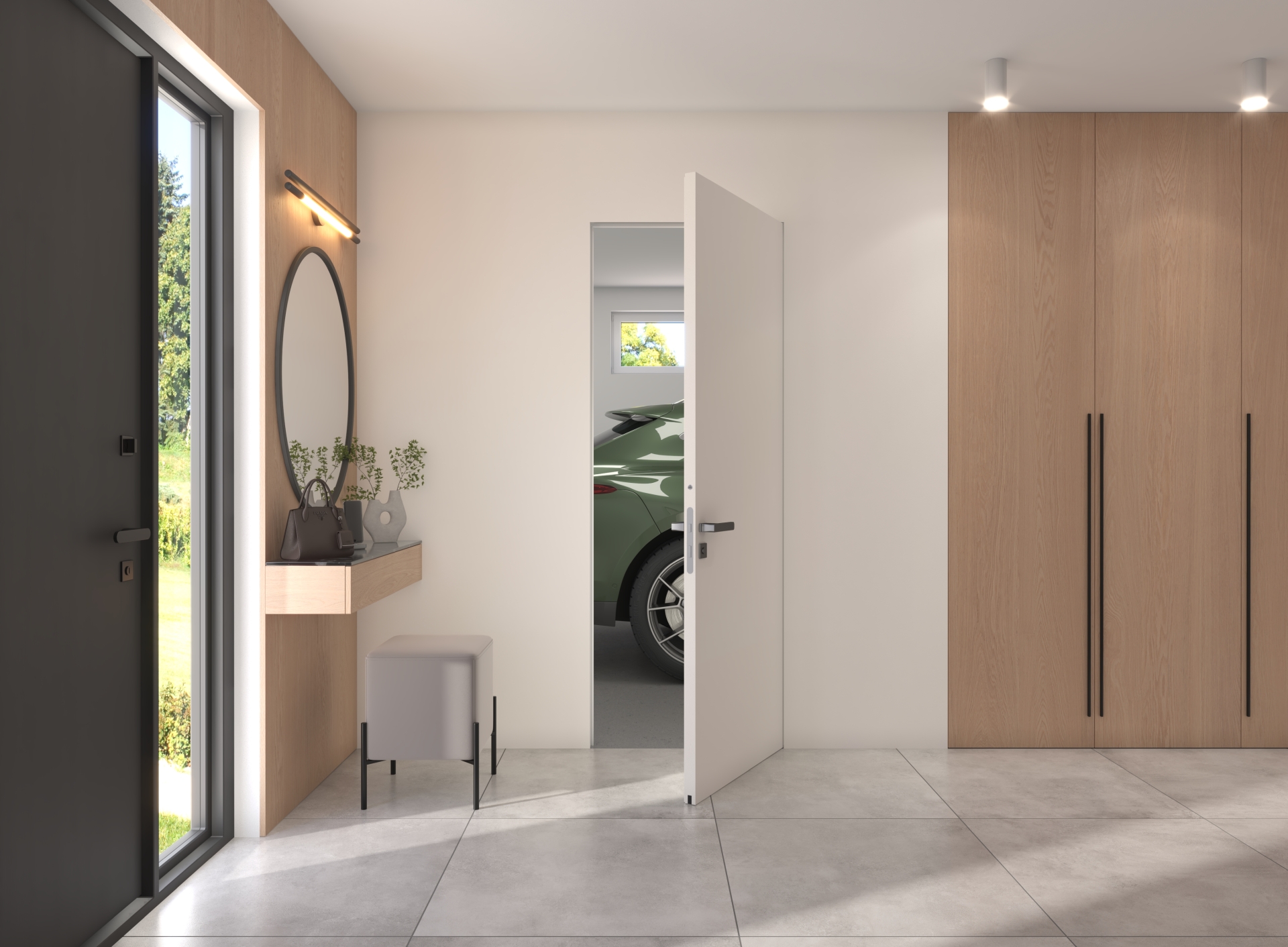
The scene was designed as a spacious, bright hallway in a modern house. We used muted colours, natural wood, light wall surfaces, large tiles and black details. The resulting interior was modern yet timeless, intended to remain relevant as trends change.
Maintaining the right balance was important. The garage could not become the main subject of the visualization, but had to be visible enough to demonstrate the door's practical use. The glimpse of the vehicle therefore provides context and makes the house layout easy to understand.
Can similar visualizations currently be created using AI?
We tried creating similar settings using available generative tools. The results could look realistic and attractive, particularly when viewed at a small size. Problems arose, however, when the exact product construction, a specific composition and full consistency across successive views had to be maintained.
For this project, the goal was not merely to create a pretty image featuring a door. We had to show a specific door model in accordance with the manufacturer's documentation and expectations.
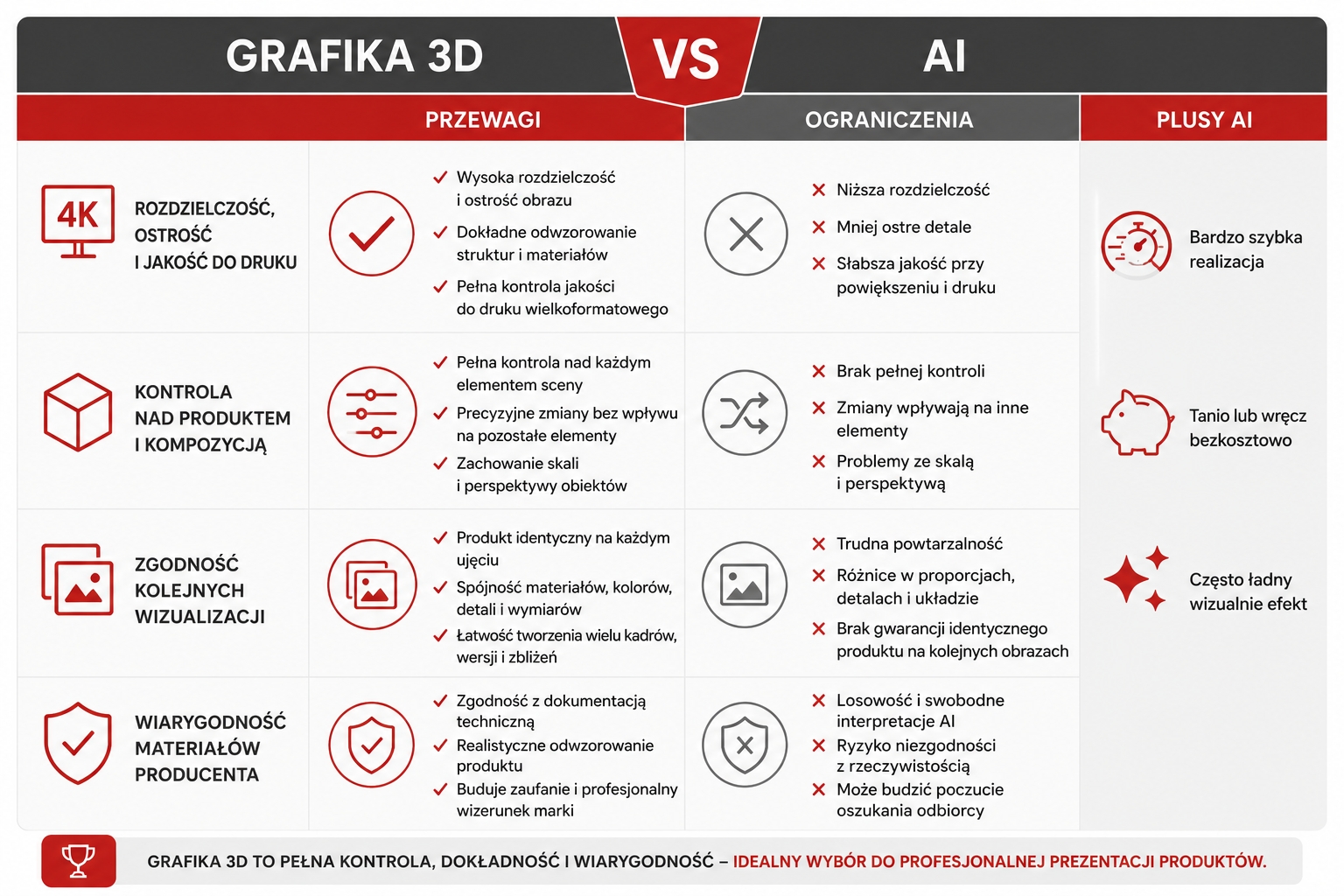
Resolution, sharpness and print quality
One of the greatest advantages of traditional 3D graphics is the ability to prepare an image at a very high resolution. A render can be generated at dimensions that meet the requirements of a catalogue, billboard, large print or trade fair display. AI-generated images often look good on screen, but enlargement can reveal blurred structures, random deformations and ambiguous details. A material may resemble wood or fabric without always preserving a specific pattern, direction or correct texture.
Control over the product and composition
In a 3D environment, every element of the scene is a separate, controlled object. We can change the door's position, the width of the opening, the wall material, the opening angle of the door leaf, the camera position or the lighting without inadvertently altering the rest of the project. When generating an image with AI, even a seemingly minor correction can change other parts of the scene. Maintaining scale and perspective is also a problem. AI can create a visually convincing image, but does not always understand the dimensional relationships between objects. This is a serious limitation when presenting a construction product.
Consistency across successive visualizations
A manufacturer often needs more than one image. Further views, colour variants, close-ups and materials for different advertising formats are created. In a traditional 3D scene, the product remains exactly the same in every render. We can change the camera or setting, while the door model retains identical proportions, hardware, seals, edges and markings. Achieving this consistency with AI is more difficult. Successive images may show similar products, but not necessarily identical ones. When presenting a specific model for sale, visual similarity alone is not enough.
Credibility of the manufacturer's materials
The viewer's reaction to the graphics also matters. A well-made 3D visualization is usually perceived much like a professional photograph. Even when viewers know they are looking at a render, they can be confident that the product has been reproduced according to its documentation. An AI-generated image may create greater uncertainty. Potential clients may wonder which elements depict the actual product and which are merely the algorithm's free interpretation. In an extreme case, they may feel that an attractive image shows a solution that does not exist in that form. This is particularly important for a manufacturer offering a high-quality product. Advertising materials should strengthen trust and show that the company takes its audience seriously. The image should not only attract attention, but also provide credible information about the product's appearance.
FAQ
frequently asked questions
Can AI replace professional 3D product visualizations?
Not at the current stage. Not for sales and catalogue materials. AI works very well for quickly creating concepts, but professional 3D visualizations provide complete control over the product, materials, dimensions and details, faithfully presenting the manufacturer's actual product.
How much does a professional 3D product visualization cost?
Prices for professional 3D product visualizations start from approximately PLN 500 net for simpler projects. The final cost depends on the model's complexity, the number of views, the interior setting, material preparation and the scope of revisions. You can read more about how we price visualizations in our 3D visualization price list.
Why do manufacturers choose 3D visualizations over AI-generated images?
3D visualizations ensure that the product matches the technical documentation and that successive views remain fully consistent. This is especially important in catalogues, advertising materials and websites, where product credibility and customer trust matter.
Project summary
The client's very well-prepared materials and detailed guidelines had a major influence on the final result. They allowed us to reproduce the client's intentions precisely and devote more attention to the details that determine the quality of a professional visualization.
It was the combination of the manufacturer's knowledge of their own product and our experience in creating photorealistic 3D graphics that made it possible to prepare images that are attractive, technically refined and credible.